Flex AI Launches First Commercial Real-Time Exercise Form Analysis Platform After Seven-Year Development Cycle
Startup solves longstanding computer vision challenge with proprietary dataset; beta testing shows 84% of users discover previously unknown form deficiencies
VANCOUVER, BC / ACCESS Newswire / December 10, 2025 / Flex AI has officially launched what industry observers are calling the first successful implementation of real-time exercise form analysis using standard smartphone cameras, marking a significant milestone in the intersection of fitness technology and artificial intelligence.
The platform, developed over seven years by CEO Amin Niri and Head of AI Amol Gharat, addresses what has been a persistent challenge in the fitness tech sector: providing accurate, immediate biomechanical feedback without requiring wearable sensors, specialized equipment, or human trainers.
Unlike previous attempts at automated form analysis most of which relied on generic pose estimation models or required controlled environments Flex built its system on a foundation that didn't previously exist in commercial fitness: a comprehensive, proprietary dataset of exercise movements annotated for biomechanical accuracy.
Solving the Data Problem
The technical challenge Flex faced was substantial. According to Gharat, "There was no commercial dataset for exercise biomechanics captured in real-world gym environments. Medical motion labs have data, but it's collected with specialized camera arrays and marker suits. Consumer fitness videos lack the detailed annotation our algorithms required."
The solution required building infrastructure from scratch. Over seven years, Flex compiled thousands of hours of exercise footage, with each frame analyzed and tagged by certified trainers for dozens of biomechanical markers joint angles, spinal positioning, weight distribution, bar path, and movement symmetry.
The result is now one of the largest proprietary exercise form datasets in the industry, forming the backbone of Flex's patented AI system.
Engineering for Real-World Conditions
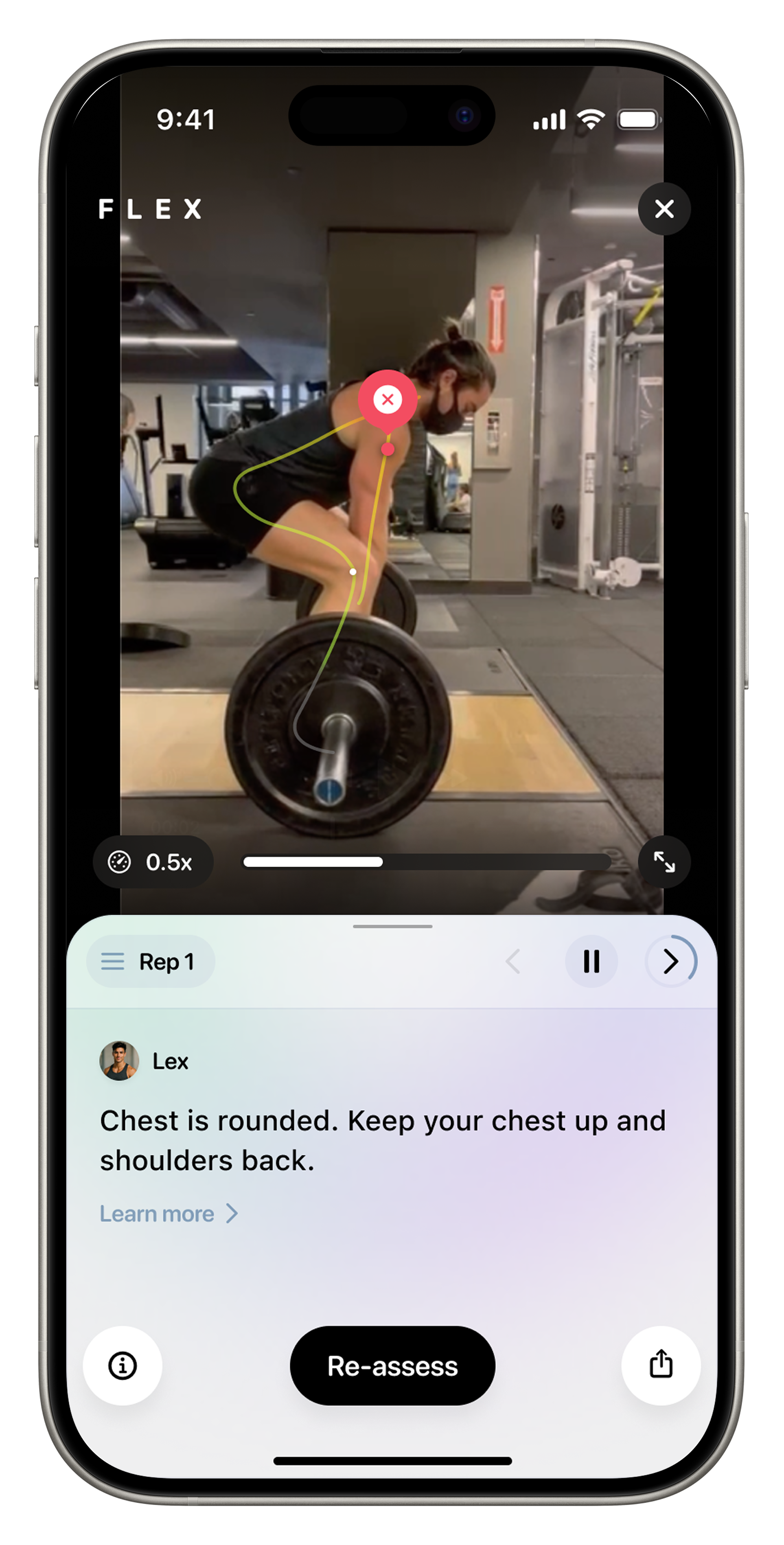
What sets Flex apart from earlier attempts is its ability to function in uncontrolled environments. Gyms present hostile conditions for computer vision: inconsistent lighting, variable camera angles and distances, equipment obstructions, and background movement.
The development team, working since 2018, engineered algorithms capable of tracking 30+ biomechanical points per frame while processing everything in real-time on mobile hardware. All analysis occurs on-device, addressing privacy concerns while eliminating latency issues associated with cloud processing.
"Standard frameworks like OpenPose and MediaPipe weren't built for this," Gharat noted. "We needed real-time feedback in messy environments, running on consumer phones. That required custom neural networks optimized for speed without sacrificing accuracy."
Beta Performance Indicates Strong Product-Market Fit
Beta testing results suggest Flex has achieved what many in the industry considered impractical:
84% of participants identified form issues they were previously unaware of
70% demonstrated measurable performance improvements within 14 days
Injury risk indicators decreased across all major compound lifts
User retention rates significantly exceeded industry benchmarks for fitness applications
One beta participant, a competitive powerlifter with eight years of experience, described the experience: "I thought my form was solid. The AI immediately caught a hip shift during squats that I'd never felt. Within a week of correcting it, my numbers went up and my knee pain disappeared."
Market Implications Beyond Consumer Fitness
While Flex is initially targeting the consumer fitness market, industry analysts note broader applications for the underlying technology. Physical therapy, athletic training, workplace ergonomics, and remote rehabilitation monitoring represent potential expansion opportunities.
The company's current development roadmap includes adaptive AI coaching that adjusts training programs based on individual biomechanics, recovery patterns, and daily readiness essentially personalized movement science delivered through smartphones.
Capital-Efficient Development in Capital-Intensive Space
What's notable about Flex's trajectory is the capital efficiency. Without access to the massive funding rounds that typically fuel AI development, the team bootstrapped infrastructure that competitors with significantly larger budgets have failed to build.
"Most fitness tech rushes to market with minimum viable products," observed one industry analyst who spoke on condition of anonymity. "Flex took the opposite approach-building real technology first, then launching when it actually worked. In a sector littered with overhyped apps that under-deliver, that's refreshing."
Positioning in Competitive Landscape
The fitness technology sector has seen numerous attempts at automated form analysis over the past decade. Most have relied on wearable sensors or required specialized camera setups, limiting adoption. Others used basic pose estimation with limited accuracy, resulting in poor user experiences and low retention.
Flex's approach leveraging proprietary datasets, custom algorithms, and on-device processing represents a different technical architecture that appears to have overcome previous limitations.
"We're not trying to replace personal trainers," Niri explained. "We're making expert-level guidance accessible at scale. The goal is augmenting human coaching, not substituting it."
As mobile processing power continues improving and edge computing capabilities expand, real-time movement analysis may become standard infrastructure across multiple industries beyond fitness from healthcare to industrial safety to sports performance.
Availability and Access
Flex AI is currently available for download through IOS , with subscription-based access to its AI coaching platform.
About Flex AI
We're a technology company focused on offering AI personal training to the world at affordable prices, with patented AI form feedback technology. Founded by Amin Niri and Amol Gharat, the company holds patents on its real-time exercise form analysis system and maintains one of the industry's largest proprietary datasets for exercise biomechanics.
For more information:
Website: flexfitnessapp.com
Instagram: @flex.ai
Founder Information:
Amin Niri, Founder & CEO: LinkedIn
Amol Gharat, Co-Founder & Head of AI: LinkedIn
Media Contact:
Brandon Gill
Info@octionagency.com
SOURCE: Flex AI
View the original press release on ACCESS Newswire
Editor Details
-
Company:
- ACCESS Newswire
- Website: