Terray’s New EMMI Predict Model Sets an Industry Performance Standard – Delivering Best-In-Class Accuracy, 26x Faster
EMMI Predict: TerraBind Solves Critical Computational Bottleneck in AI-driven Drug Discovery
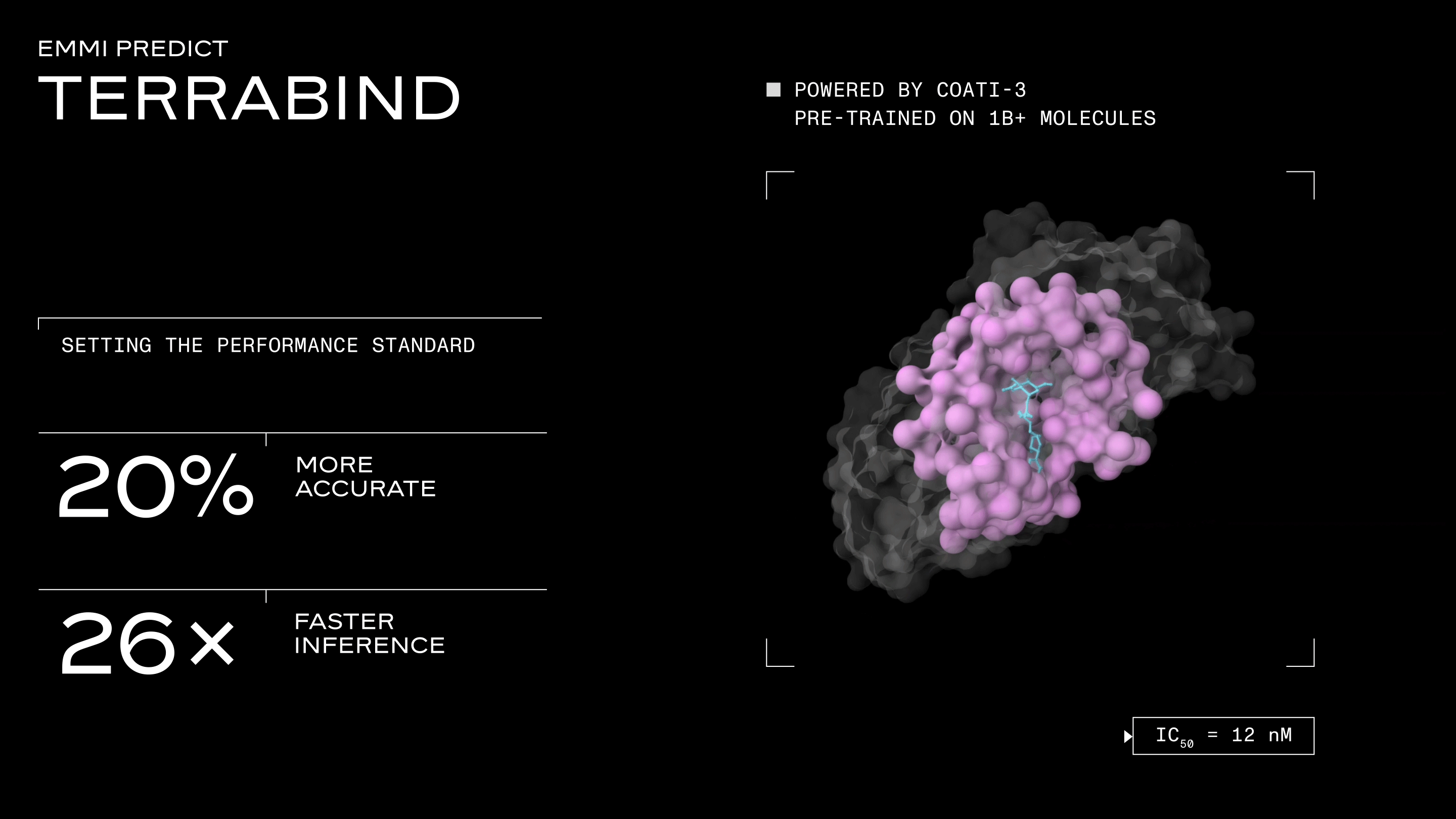
LOS ANGELES--(BUSINESS WIRE)--#biotech--Terray Therapeutics today unveiled the latest EMMI prediction model, a universal potency model that outperforms the industry: achieving 20% higher accuracy than industry-leading open-source models while running 26x faster, reducing inference cost by 96%.
Terray’s platform is where Experimentation Meets Machine Intelligence (EMMI) to transform the speed, cost, and, most importantly, the success rate of small molecule drug discovery. Every design decision is focused on developing practical AI that accelerates Terray’s de-novo small molecule discovery and development across internal and partnered programs with BMS, Gilead and Odyssey Therapeutics.
At the heart of EMMI is a full stack of AI models that tackle each molecule design challenge by leveraging Terray’s proprietary chemistry foundation model to Generate millions of structures that address the challenge, Predict the drug properties for those structures, and Select the optimal set of molecules for synthesis and testing.
Terray developed EMMI Predict: TerraBind (“TerraBind”) to provide universal potency prediction at the scale necessary for small molecule drug development. Terray needed a model that could handle millions of molecules. Other prediction models are impractical at this scale due to their use of a computationally intensive diffusion step.
The architecture shift also increases accuracy. In side-by-side tests, TerraBind is more accurate than Boltz-2, the latest model available for comparison, on both a public benchmark and internal drug discovery targets. On the CASP16 benchmark, TerraBind achieves 16% higher Pearson correlation than Boltz-2. Across 18 internal drug discovery targets spanning diverse protein families and chemical scaffolds, TerraBind outperforms Boltz-2 by 20% on average, demonstrating robust generalization to real-world pharmaceutical development challenges. On benchmarks, including FoldBench, PoseBusters, and Runs N' Poses, TerraBind matches Boltz-2 ligand pose accuracy and does it 26x faster.
“This breakthrough in binding affinity prediction is a cornerstone in our AI-driven, experimental workflow. EMMI is grounded in the largest chemistry data set in the world, currently at 14B unique target-molecule measurements, which has consistently enabled EMMI to find starting points for undruggable targets in the dark areas of chemical space,” stated Jacob Berlin, CEO, Terray. “Combining this latest version of TerraBind with Generate and Select, we have an integrated AI-workflow that drives optimization of these unique starting points with best-in-class efficiency.”
Rethinking the Architecture of Binding Prediction
The breakthrough in the newest version of TerraBind stems from a fundamental reimagining of the steps necessary to generate accurate binding predictions and the fidelity of protein-ligand structures. While recent prediction models like AlphaFold3 and Boltz-2 achieve impressive accuracy through computationally expensive all-atom diffusion processes, Terray’s research team hypothesized that this level of structural detail wasn’t required for the core task of predicting how tightly a molecule binds to a protein and where, which are crucial steps in identifying novel molecules for development.
Instead, TerraBind learns on coarse-grained structural representations—using only protein residue centers and ligand heavy atoms— then maps those representations directly to binding affinity. By eliminating the diffusion module entirely, TerraBind achieves what seemed contradictory: faster inference and more accurate predictions.
TerraBind also provides the foundation for EMMI Select models to choose the optimal molecules for synthesis and testing in every cycle to rapidly progress programs. Recently announced, EMMI’s selection models combine Epistemic Neural Networks with an acquisition function such as expected maximum (EMAX) to directly incorporate model uncertainty in synthesis selections. In retrospective benchmarking for potency optimization, this approach dramatically outperforms existing methods, with time and cost savings of 3x.
Implications for Drug Discovery
Terray’s relentless focus on building practical AI that impacts small molecule drug discovery and development has produced an industry leading AI-workflow capable of leveraging both Terray’s internal data and external data to compress drug discovery timelines. The integrated EMMI platform is consistently able to identify novel molecular scaffolds for a wide variety of targets and rapidly optimize these de novo molecules. This paradigm shift is accelerating the development of new medicines for patients in need through both Terray’s internal and partnered programs.
Interested in going deeper? Read our Blog.
About Terray Therapeutics
Terray is an AI-native, chemistry-powered biotechnology company founded at the convergence point of machine intelligence, human intellect, and medicine. The company built its own dataset, designed its own hardware, and trained its own AI to turn impossible drug discovery challenges into inevitable small-molecule solutions. The result is an interconnected platform that enables deep collaboration in all areas—between AI and people, chemistry and biology, hardware and software, and data and design.
Contacts
Media Contact
Erika Shaffer
Press@terraytx.com
Editor Details
-
Company:
- Businesswire