
US$ 269.56 Billion by 2034: The Decade Life Sciences Took Control of Healthcare’s Future
I’ve spent years studying, writing about, and engaging with leaders across pharmaceuticals, biotechnology, diagnostics, and digital health. If there’s one truth I’ve learned, it’s this: life sciences quietly shape the future of humanity long before the world notices.
Today, the global life science market; valued at US$ 88.2 billion in 2024 and projected to reach US$ 269.56 billion by 2034; is not just expanding. It’s evolving in purpose, pace, and responsibility. Behind these numbers are stories of researchers racing against time, startups challenging convention, and technologies redefining what medicine can achieve.
Download Customized Sample for Free: https://www.towardshealthcare.com/download-sample/5711
This is not just market growth.
This is human progress in motion.
Why Life Sciences Matter More Than Ever
Life sciences sit at the heart of everything we associate with better living; longer life expectancy, early disease detection, safer drugs, and smarter healthcare systems. From the medicines we rely on daily to breakthrough therapies that treat previously incurable diseases, life sciences quietly power modern healthcare.
Over the years, I’ve watched this industry move beyond traditional drug development. It now blends biology with data, engineering, and artificial intelligence. The result is a sector that doesn’t just react to disease; but increasingly predicts, prevents, and personalizes care.
Healthcare is no longer reactive. Life sciences are making it proactive.
The Growth Story Behind the Headlines
The numbers tell a compelling story. The market is growing at a CAGR of 11.82%, fueled by rising R&D investments, expanding access to healthcare, and rapid technological innovation. Pharmaceuticals dominated the market in 2024, but biotechnology is emerging as the fastest-growing segment, reshaping how treatments are designed and delivered.
What excites me most is that this growth is not concentrated in one corner of the world. North America currently leads, but Asia-Pacific is accelerating at the fastest pace. Europe, Latin America, and the Middle East & Africa are no longer peripheral; they are becoming innovation hubs in their own right.
Life science growth today is global, inclusive, and deeply interconnected.
From One-Size-Fits-All to Truly Personal Care
One of the most meaningful shifts I’ve seen is the rise of personalized medicine. Instead of treating symptoms broadly, therapies are increasingly tailored to a person’s genetic makeup, lifestyle, and disease biology.
This shift is driven by advancements in genomics, proteomics, and bioinformatics. Scientists are now able to understand diseases at a molecular level, enabling treatments that are more precise and far more effective.
Personalized medicine is not a luxury anymore.
It’s quickly becoming the new standard of care.
The Silent Power of Technology in Life Sciences
Technology has become the invisible engine driving the life science market forward. Artificial intelligence, machine learning, cloud platforms, and automation are embedded across the entire value chain.
AI is accelerating drug discovery by identifying promising compounds faster than traditional methods ever could. Clinical trials are becoming smarter, shorter, and more patient-centric through digital tools. Manufacturing is evolving into intelligent, compliant, and scalable ecosystems.
From my experience, companies that embrace digital transformation don’t just innovate faster; they survive longer.
Money Is Flowing Where Science Is Strong
Investment momentum in life sciences is stronger than I’ve ever seen. Every year, hundreds of billions of dollars flow into licensing deals, mergers, acquisitions, and venture funding. This capital is not speculative; it’s strategic.
Global leaders such as AstraZeneca, Eli Lilly and Company, Novartis, Pfizer, and Roche continue to invest heavily in next-generation therapies, AI-driven platforms, and global expansion.
At the same time, technology-focused firms like Thermo Fisher Scientific and Schrödinger, Inc. are transforming how research, simulation, and analytics are performed.
Capital follows conviction; and conviction in life sciences is stronger than ever.
Oncology, Infections, and the Fight That Never Stops
Cancer remains the dominant therapeutic area in the life science market. Rising incidence rates, complex disease biology, and continuous innovation keep oncology at the forefront of research and investment.
Yet infectious diseases are emerging as the fastest-growing segment. Global health programs, government initiatives, and post-pandemic awareness have reignited focus on prevention, early detection, and rapid treatment.
Cardiology, neurology, and rare diseases are also gaining momentum as gene therapies, RNA-based treatments, and regenerative medicine open new frontiers.
Every therapeutic breakthrough represents hope; for patients, families, and entire healthcare systems.
Regulation and Data: The Necessary Balancing Act
Growth rarely comes without challenges. Regulatory compliance remains one of the biggest hurdles for life science companies. Navigating evolving global regulations while maintaining innovation requires experience, agility, and ethical discipline.
Data privacy is another critical concern. As digital tools and AI platforms become more common, safeguarding patient data is no longer optional; it’s foundational to trust.
In my experience, companies that build compliance and ethics into their innovation strategy grow more sustainably than those that treat regulation as an afterthought.
Asia-Pacific: The Next Powerhouse of Life Sciences
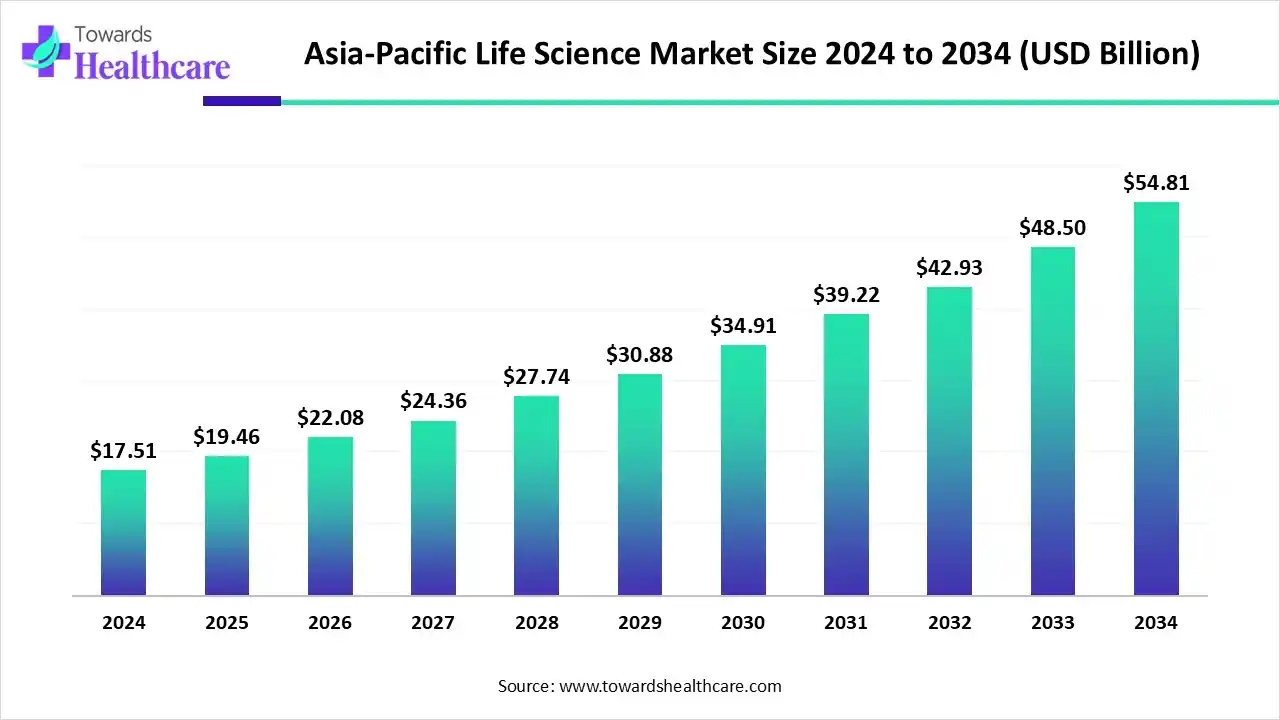
Asia-Pacific is the most exciting region to watch. China and India are rapidly expanding their biotech ecosystems, supported by government funding, venture capital, and a growing pool of skilled scientists.
India’s rise in biotech startups and clinical research capabilities is particularly notable. China’s patent growth and manufacturing scale are reshaping global supply chains.
Asia-Pacific is not just catching up.
It’s redefining how fast life science ecosystems can scale.
What the Next 10 Years Will Look Like
Looking ahead to 2034, I see a life science industry that is smarter, faster, and far more human-centric. Genetic engineering tools like CRISPR, the expansion of digital health, and the rise of generative AI will fundamentally change how therapies are discovered and delivered.
Life sciences will play a central role in economic growth, national security, and public health resilience. The companies that succeed will be those that combine science with empathy, technology with trust, and innovation with responsibility.
After more than a decade in this field, I can confidently say this:
the life science market is not just building better healthcare; it is building a better future for humanity.

Editor Details
-
Company:
- Towards Healthcare
-
Name:
- Sneha More
- Email:
-
Telephone:
- +919356928204
- Website:
