
CMS Hemp Program Insiders Admit Bypassing FDA Safety Standards for a Potential $34.5 Billion Medicare Payday
WASHINGTON, DC / ACCESS Newswire / May 14, 2026 / As a federal judge prepares to rule on the legality of the Centers for Medicare & Medicaid Services' (CMS) cannabinoid access program, newly surfaced public statements from industry participants are intensifying scrutiny surrounding the entire initiative.
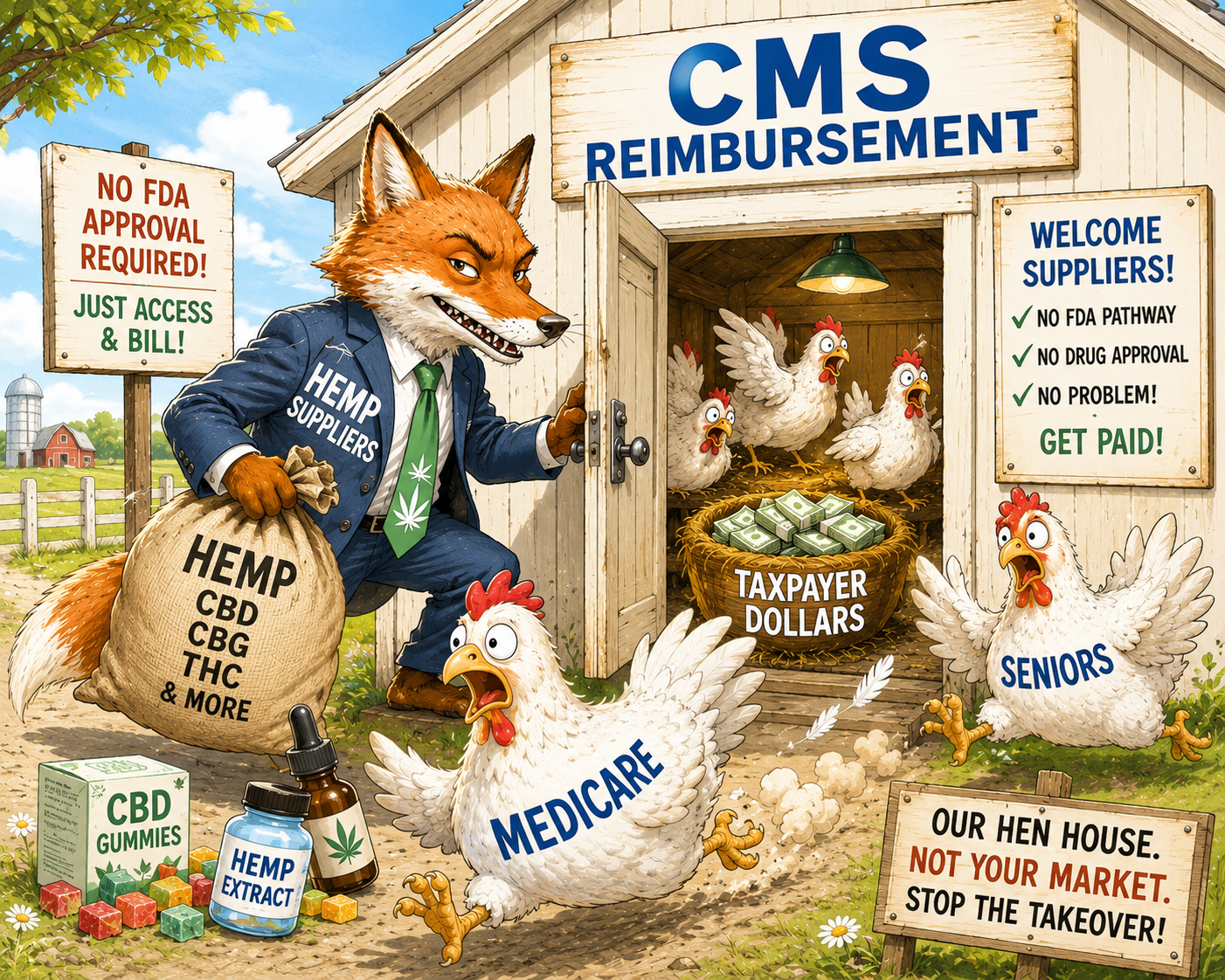
At issue is the CMS Substance Access Beneficiary Engagement Incentive (BEI) program, currently under review in:
Smart Approaches to Marijuana et al. v. Robert F. Kennedy Jr. et al.
Case No. 1:26-cv-01081 (D.D.C.)
The lawsuit challenges whether CMS exceeded its authority by permitting provider-mediated furnishing of hemp-derived cannabinoid products inside Medicare-connected healthcare systems without traditional FDA drug approval standards.
Now, public statements from individuals actively participating in the BEI ecosystem are raising additional questions about whether the FDA pathway itself is being treated as optional.
"We Don't Have To Go Down the FDA Pathway"
In a publicly circulated discussion involving cannabinoid healthcare commercialization strategies, one participant stated:
"We don't have to go down the FDA pathway of being approved..."
while suggesting that safety findings associated with the FDA approved drug Epidiolex could effectively support broader CBD commercialization efforts across other products and companies.
Critics argue that is not how federal drug law works.
Epidiolex's FDA approval applies:
to that specific product
that specific manufacturer
and that specific regulatory submission.
It does not create blanket FDA approval for unrelated cannabinoid products entering Medicare connected healthcare channels.
"The Data Is In Healthcare Much Quicker Than the Biology"
Another statement from the same discussion may prove even more significant.
One participant described the cannabinoid rollout strategy by stating:
"The data is in healthcare much quicker than the biology."
Critics say that quote effectively summarizes the core legal issue now before the federal court:
Is CMS allowing healthcare infrastructure and commercial distribution channels to expand before the underlying scientific standards are fully established?
The Conversation Was About Market Scale - Not Clinical Trials
The discussion also reportedly focused heavily on:
physician outreach
ACO pipeline development
dosing algorithms
convention marketing
provider adoption
and commercialization strategy.
One participant openly calculated the potential market opportunity using:
69 million Medicare beneficiaries
at $500 annually per patient
arriving at a projected:
$34.5 billion total addressable market.
Critics argue the conversation sounded less like a clinical research discussion and more like the construction of a national healthcare sales infrastructure.
Even Participants Admit Product Standards Are Not Fully Solved
The transcript also reportedly includes acknowledgments that:
formulation consistency
cannabinoid ratios
and standardized dosing
do not yet exist consistently across much of the cannabinoid marketplace.
At the same time:
Europe's EFSA concluded CBD safety "cannot be established"
Congress directed DEA and FDA to crack down on cannabinoid products threatening consumer safety
and the FDA itself continues to maintain unresolved concerns involving CBD toxicology and long-term safety.
MMJ International Followed the FDA-and-DEA Pharmaceutical Pathway Instead
Unlike companies now entering BEI healthcare channels, MMJ International Holdings pursued:
FDA Investigational New Drug applications
DEA registration infrastructure
pharmaceutical manufacturing controls
orphan-drug development
and federally compliant cannabinoid clinical pathways.
MMJ argues the BEI program effectively created:
healthcare access first - science later
while companies operating through the FDA pharmaceutical pathway spent years completing the scientific work CMS-linked suppliers are now publicly describing as avoidable.
A Federal Judge Must Now Decide
Judge Trevor N. McFadden now faces an increasingly difficult administrative-law question:
Did CMS move beyond healthcare innovation and into therapeutic commercialization before the science, safety standards, and FDA framework were fully established?
As more public statements emerge from BEI participants themselves, critics argue the federal government's own healthcare-access experiment is beginning to describe its underlying strategy in plain language:
commercial expansion now, scientific certainty later.
And that is precisely the question now sitting before the federal court in Washington.
Madison Hisey
MHisey@mmjih.com
203-231-8583
SOURCE: MMJ International Holdings
View the original press release on ACCESS Newswire
Editor Details
-
Company:
- ACCESS Newswire
- Website:
