Clinical research - Articles
Case management workflow software modernizes pharmacological by digitizing workflows, reducing errors, and ensuring regulatory compliance. It speeds up case processing, improves accuracy, provides audit-ready data, and supports global scalability. By enabling collaboration and data-driven decisions, it transforms PV into a strategic advantage that safeguards patients and strengthens operational efficiency.
Pharmacovigilance (PV) as the cornerstone of drug safety, committed to safeguarding patient health by systematically monitoring, analyzing, and mitigating the risks associated with therapeutic products from pre-clinic stages through post-market oversight.As the innovation pipeline delivers a broader range of therapies, and as global clinical trials and ever-broader regulatory expectations…
Pharmacovigilance (PV) as the cornerstone of drug safety, committed to safeguarding patient health by systematically monitoring, analyzing, and mitigating the risks associated with therapeutic products from pre-clinic stages through post-market oversight.As the innovation pipeline delivers a broader range of therapies, and as global clinical trials and ever-broader regulatory expectations…
The CBH Biospecimen Marketplace is an online biobank and biorepository built for teams who need human biological samples with audit-ready documentation and dependable logistics. Our continuously curated biological specimen inventory exceeds a quarter of a million active units and spans serum, plasma, whole blood, PBMC for research, urine samples, cerebrospinal fluid (CSF), saliva, stool/feces/faeces, swab samples, and human tissue (FFPE and frozen). You can search, filter, compare, and order human biospecimens for research, development, and production—not only RUO feasibility. What differentiates the platform is scientific traceability: standardized preanalytics, transparent biospecimen data, and route-proven cold-chain shipping.
What Counts as a Human Biological Specimen? Human biol…
What Counts as a Human Biological Specimen? Human biol…
The United States Food and Drug Administration’s (FDA’s) Accelerated Approval (AA) pathway, initially established in 1992 during the HIV/AIDS epidemic to provide faster access to life-saving treatments, has been instrumental in expediting access to therapies for serious and life-threatening conditions. It is particularly significant in therapeutic areas, such as rare diseases, where surrogate or intermediate clinical endpoints may be necessary due to limited patient populations or slow disease progression. While this approach has encouraged innovation, it has also raised concerns about drugs staying on the market without confirmed evidence of their effectiveness.
The United States Food and Drug Administration’s (FDA’s) Accelerated Approval (AA) pathway, initially established in 1992 during…
The United States Food and Drug Administration’s (FDA’s) Accelerated Approval (AA) pathway, initially established in 1992 during…
Investigator-Initiated Trials have shifted from small academic projects to a powerful driver of clinical innovation. They address unmet patient needs, attract diverse funding, gain regulatory acceptance, and generate real-world evidence.
However, investigators face barriers like regulatory complexity, operational burdens, funding gaps, and publication pressure.
CROs play a crucial role by providing protocol design, regulatory navigation, trial operations, data management, safety monitoring, and publication support. For sponsors, IITs offer early innovation insights, post-marketing data, and stronger credibility
The Rise of Investigator-Initiated Trials: A CRO’s Guide to Enabling Innovation Investigator-initiated trials (IITs) have progressively shifted from specialized academic projec…
The Rise of Investigator-Initiated Trials: A CRO’s Guide to Enabling Innovation Investigator-initiated trials (IITs) have progressively shifted from specialized academic projec…
Clinical research studies are the backbone of medical progress this article explains five key types observational, longitudinal, cross-sectional, case-control and experimental helping you understand how each plays a role in advancing treatments and improving patient care.
Have you ever stopped to think about how a new medication gets from a scientist lab to your local pharmacy shelf? It is not just a guess or a hope it is a journey driven by the incredible power of data every medical breakthrough from a groundbreaking cancer treatment to a simple new vaccine is the result of painstaking and methodical work known as clinical research this field is all about asking the right questions and finding reliable answers that can change lives if you are fascinated by the science behind medicine or ar…
Have you ever stopped to think about how a new medication gets from a scientist lab to your local pharmacy shelf? It is not just a guess or a hope it is a journey driven by the incredible power of data every medical breakthrough from a groundbreaking cancer treatment to a simple new vaccine is the result of painstaking and methodical work known as clinical research this field is all about asking the right questions and finding reliable answers that can change lives if you are fascinated by the science behind medicine or ar…
To become a successful Clinical Research Associate (CRA) start by completing a clinical research course to gain strong knowledge of research processes and regulations. Build practical skills through internships or entry-level roles and focus on clear communication and attention to detail. Staying updated with industry trends and certifications will help you grow in this rewarding career.
When you think about the incredible work that goes into bringing a new medicine to people who need it a key part of that effort is carried out by a person called a Clinical Research Associate or CRA. A CRA is a vital link between the company that makes a medicine and the doctors and hospitals that are testing it. They travel to different study sites making sure everything is done carefully and according to…
When you think about the incredible work that goes into bringing a new medicine to people who need it a key part of that effort is carried out by a person called a Clinical Research Associate or CRA. A CRA is a vital link between the company that makes a medicine and the doctors and hospitals that are testing it. They travel to different study sites making sure everything is done carefully and according to…
CRAs can elevate their careers into roles such as Project or Trial Manager and Medical Science Liaison—stepping into leadership, operational oversight, or scientific strategy after gaining hands‑on trial experience.
Many Clinical Research Associates (CRAs) eventually wonder: what’s next? Mike Wood outlines five compelling post‑CRA trajectories in clinical research, each delivering more strategy, leadership, or scientific impact. Clinical Project Manager (CPM): Lead entire trials, from budgeting to timelines and team coordination. Ideal for those keen on big‑picture involvement. Clinical Trial Manager (CTM): Focus on operations—overseeing site performance, supervising CRAs, and keeping trials inspection‑ready. Great for aspiring leaders. Clinical Research Scientist / Medical Science…
Many Clinical Research Associates (CRAs) eventually wonder: what’s next? Mike Wood outlines five compelling post‑CRA trajectories in clinical research, each delivering more strategy, leadership, or scientific impact. Clinical Project Manager (CPM): Lead entire trials, from budgeting to timelines and team coordination. Ideal for those keen on big‑picture involvement. Clinical Trial Manager (CTM): Focus on operations—overseeing site performance, supervising CRAs, and keeping trials inspection‑ready. Great for aspiring leaders. Clinical Research Scientist / Medical Science…
In order to prepare for future disruptions, this article looks at how clinical trial teams should develop strong and flexible research methods with careful planning clinical trials can continue as planned even during uncertain times this demonstrates the lessons acquired during the COVID-19 pandemic and offers practical steps to improve trial continuity, patient safety and regulatory compliance.
In the past few years, the healthcare world has faced some of its toughest challenges the COVID-19 pandemic was a wake up call for everyone especially for those involved in clinical trials many trials were delayed, paused or even stopped due to safety concerns and logistical issues this situation showed the importance of building flexible and strong clinical trial protocols that can survive such glo…
In the past few years, the healthcare world has faced some of its toughest challenges the COVID-19 pandemic was a wake up call for everyone especially for those involved in clinical trials many trials were delayed, paused or even stopped due to safety concerns and logistical issues this situation showed the importance of building flexible and strong clinical trial protocols that can survive such glo…
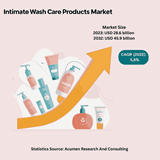
The intimate wash care products industry is projected to grow steadily through 2032, driven by changing hygiene standards, rising awareness, and evolving consumer preferences. Explore trends, market share insights, and growth drivers.
In recent years, the global health and wellness industry has seen an unprecedented evolution—not only in mainstream personal care but also in intimate hygiene. Among the most dynamic and increasingly visible segments is the intimate wash care products category, which has transitioned from niche awareness to everyday consumer routines in many parts of the world. As per data released by Acumen Research and Consulting, the global intimate wash care product market was valued at USD 28.6 billion in 2023 and is projected to reach USD 45.9 billion by 2032, expanding…
In recent years, the global health and wellness industry has seen an unprecedented evolution—not only in mainstream personal care but also in intimate hygiene. Among the most dynamic and increasingly visible segments is the intimate wash care products category, which has transitioned from niche awareness to everyday consumer routines in many parts of the world. As per data released by Acumen Research and Consulting, the global intimate wash care product market was valued at USD 28.6 billion in 2023 and is projected to reach USD 45.9 billion by 2032, expanding…
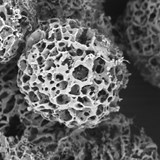
Examine the Regenerative Medicine Scaffolds Market growth—from USD 336.5 Million in 2023 to USD 1.72 Billion by 2032 at a 20.2% CAGR. Learn key trends, technology advances, regional dynamics, and tissue repair innovations reshaping healthcare.
Biomaterials engineered to restore, replace, or augment damaged tissues are gaining momentum—and at the core are Regenerative Medicine Scaffolds, critical in advancing tissue repair across orthopedics, neurology, wound healing, and cardiovascular applications. Our recent analysis at Acumen Research & Consulting sheds light on shifting market dynamics, emerging technologies, and region-wise growth projections. Market Size & Growth Outlook The Regenerative Medicine Scaffolds Market Size reached USD 336.5 million in 2023 and is forecast to so…
Biomaterials engineered to restore, replace, or augment damaged tissues are gaining momentum—and at the core are Regenerative Medicine Scaffolds, critical in advancing tissue repair across orthopedics, neurology, wound healing, and cardiovascular applications. Our recent analysis at Acumen Research & Consulting sheds light on shifting market dynamics, emerging technologies, and region-wise growth projections. Market Size & Growth Outlook The Regenerative Medicine Scaffolds Market Size reached USD 336.5 million in 2023 and is forecast to so…
Health Studio offers a fully integrated, AI-powered platform to modernize clinical trials by solving key bottlenecks like slow recruitment and fragmented data. Built on Google Cloud, it centralizes the entire research lifecycle with digital onboarding, near real-time dashboards for remote participant monitoring via wearables, and seamless data integration with EHRs and REDCap. The platform's built-in AI provides predictive analytics to forecast dropout risk and detect adverse events, enabling researchers to run faster, smarter, and more adaptive trials while reducing costs and improving participant safety.
AI-Powered Clinical Trials: A New Era of Research with Health Studio Clinical trials are the backbone of medical advancement but they’ve historically been slow, costly…
AI-Powered Clinical Trials: A New Era of Research with Health Studio Clinical trials are the backbone of medical advancement but they’ve historically been slow, costly…

Artificial intelligence is transforming clinical research by helping predict trial outcomes more accurately, saving time, reducing costs and improving patient safety.
Artificial Intelligence (AI) is no longer just a buzzword it is transforming the way healthcare is delivered and its influence is now reaching deep into the world of clinical trials from predicting patient responses to helping researchers design better studies. AI is playing a growing role in how new drugs and therapies are tested with this shift the expectations from professionals in the research field are changing too, making it more important than ever to be trained with a strong foundation something a well designed clinical research course can now offer to future researchers and healthcare professionals. Clinical trials ar…
Artificial Intelligence (AI) is no longer just a buzzword it is transforming the way healthcare is delivered and its influence is now reaching deep into the world of clinical trials from predicting patient responses to helping researchers design better studies. AI is playing a growing role in how new drugs and therapies are tested with this shift the expectations from professionals in the research field are changing too, making it more important than ever to be trained with a strong foundation something a well designed clinical research course can now offer to future researchers and healthcare professionals. Clinical trials ar…
09-Jul-2025
Nicolas Wolikow is a French entrepreneur and co-founder and CEO of Cure51. A graduate of Sciences Po and HEC, he began his career in a ministerial cabinet (Quai d'Orsay) and then within major French groups (L'Oréal, Sodexo) in marketing and international development roles (opening subsidiaries in emerging countries).
1. Let’s start with the big picture — what inspired the founding of Cure51, and what core mission drives the company today? The original spark behind Cure51 came from a simple but powerful observation: some patients with very advanced cancer live far beyond expectations—and yet we rarely ask why. In most oncology R&D models, these exceptional survivors are statistical outliers, often excluded from clinical analysis. At Cure51, we decided to flip that thinking. What if these…
1. Let’s start with the big picture — what inspired the founding of Cure51, and what core mission drives the company today? The original spark behind Cure51 came from a simple but powerful observation: some patients with very advanced cancer live far beyond expectations—and yet we rarely ask why. In most oncology R&D models, these exceptional survivors are statistical outliers, often excluded from clinical analysis. At Cure51, we decided to flip that thinking. What if these…
The Medical Telepresence Robots Market is projected to grow from USD 66.2 million in 2023 to USD 322.1 million by 2032, at a CAGR of 19.3%. This growth is driven by the rise in telemedicine, healthcare professional shortages, aging populations, and the need for infection control. Key market trends include AI integration, 5G connectivity, and expanding use in hospitals, home care, and senior living. North America leads the market, with Asia-Pacific emerging as the fastest-growing region.
Medical Telepresence Robots Market Overview: Unlocking the Future of Remote Healthcare In an increasingly digital healthcare landscape, Medical Telepresence Robots are emerging as a game-changing solution to bridge gaps in care delivery, especially in underserved or geographically distant locations. Accordin…
Medical Telepresence Robots Market Overview: Unlocking the Future of Remote Healthcare In an increasingly digital healthcare landscape, Medical Telepresence Robots are emerging as a game-changing solution to bridge gaps in care delivery, especially in underserved or geographically distant locations. Accordin…
Big data is changing clinical research by helping doctors choose the right patients, understand results better, and speed up the process of finding new treatments. This makes medical studies faster and more accurate.
The way we study new medicines and treatments is changing quickly. One of the biggest reasons for this change is the use of artificial intelligence (AI) and big data in clinical research. These technologies are helping doctors and researchers collect, understand and use medical information faster and better than before. During a good clinical research course students often learn how new tools like AI and big data are now part of modern research work. In the past, clinical research relied mostly on paperwork, manual data entry and slow methods to find answers. Today, computers c…
The way we study new medicines and treatments is changing quickly. One of the biggest reasons for this change is the use of artificial intelligence (AI) and big data in clinical research. These technologies are helping doctors and researchers collect, understand and use medical information faster and better than before. During a good clinical research course students often learn how new tools like AI and big data are now part of modern research work. In the past, clinical research relied mostly on paperwork, manual data entry and slow methods to find answers. Today, computers c…
As awareness grows and technology advances, Guillain-Barré Syndrome is becoming less of a mystery—and more of a manageable, diagnosable condition. The future of GBS care starts with faster answers.
While it is not a common condition, Guillain-Barré Syndrome (GBS) is garnering increased interest from the broader medical diagnostics industry as new cases are reported worldwide each year and linked to a range of triggers including infections, immunizations, or idiopathic origins. Early detection followed by appropriate care and treatment is a key need in GBS, which can lead to paralysis and other serious complications if left untreated. The global Guillain-Barré Syndrome diagnostics market is expected to show steady growth during the forecast period (2024-2030) with several factors such as gr…
While it is not a common condition, Guillain-Barré Syndrome (GBS) is garnering increased interest from the broader medical diagnostics industry as new cases are reported worldwide each year and linked to a range of triggers including infections, immunizations, or idiopathic origins. Early detection followed by appropriate care and treatment is a key need in GBS, which can lead to paralysis and other serious complications if left untreated. The global Guillain-Barré Syndrome diagnostics market is expected to show steady growth during the forecast period (2024-2030) with several factors such as gr…
ePRO transforms clinical trials by replacing paper diaries—improving patient compliance, reducing data queries, and enabling real-time digital data capture.
ePRO isn’t just digitized data collection. It’s real-time, structured, regulatory-grade intelligence, designed to enhance compliance, cut down queries, and keep patients engaged. Despite operating in a digitally driven world, many clinical trials continue to rely on old-fashioned paper diaries to collect patient-reported data. As recently as 2018, nearly half of all studies capturing patient outcomes were still using paper. And that dependence hasn’t vanished overnight. Paper diaries come with known risks: missing data, unreadable handwriting, and “parking lot compliance”, when patients rush to fill in days of entries just before a sit…
ePRO isn’t just digitized data collection. It’s real-time, structured, regulatory-grade intelligence, designed to enhance compliance, cut down queries, and keep patients engaged. Despite operating in a digitally driven world, many clinical trials continue to rely on old-fashioned paper diaries to collect patient-reported data. As recently as 2018, nearly half of all studies capturing patient outcomes were still using paper. And that dependence hasn’t vanished overnight. Paper diaries come with known risks: missing data, unreadable handwriting, and “parking lot compliance”, when patients rush to fill in days of entries just before a sit…
An electronic data capture system is a software solution designed to electronically collect, manage, and store data for clinical trials.
What is an Electronic Data Capture (EDC) System in Clinical Trials? Electronic Data Capture (EDC) systems are specialised software platforms designed to collect, manage, and store data in clinical trials. They replace traditional paper-based methods with secure, efficient, and highly accurate digital solutions. By automating data collection and streamlining management processes, EDC systems enhance data quality, minimise errors, and ensure compliance with regulatory standards. These systems are essential for modern clinical research, enabling real-time data access and integration with other clinical trial tools, thereby improving overall trial efficiency a…
What is an Electronic Data Capture (EDC) System in Clinical Trials? Electronic Data Capture (EDC) systems are specialised software platforms designed to collect, manage, and store data in clinical trials. They replace traditional paper-based methods with secure, efficient, and highly accurate digital solutions. By automating data collection and streamlining management processes, EDC systems enhance data quality, minimise errors, and ensure compliance with regulatory standards. These systems are essential for modern clinical research, enabling real-time data access and integration with other clinical trial tools, thereby improving overall trial efficiency a…

In 2025, clinical trials are becoming faster, smarter, and more patient-focused. Key trends include AI-powered document management, digital collaboration via CTMS and eTMF, remote trial oversight, and stronger patient engagement. Rare disease research is growing, and data-driven tools are essential for operational success.
The landscape of clinical trials is rapidly transforming. As we move through 2025, smarter technologies and patient-centric approaches are redefining how studies are designed, managed, and delivered. This article explores the critical developments shaping today’s clinical research – from artificial intelligence to virtual trial oversight and growing attention to rare diseases. Whether you're a sponsor, CRO, or research site, staying ahead of these shifts is vital to succe…
The landscape of clinical trials is rapidly transforming. As we move through 2025, smarter technologies and patient-centric approaches are redefining how studies are designed, managed, and delivered. This article explores the critical developments shaping today’s clinical research – from artificial intelligence to virtual trial oversight and growing attention to rare diseases. Whether you're a sponsor, CRO, or research site, staying ahead of these shifts is vital to succe…
Verified Clinical Trials helps sponsors detect duplicate and professional subjects, and other important protocol violations.
In today’s rapidly evolving clinical research landscape, one of the most critical—and often overlooked—threats to trial success is the enrollment of duplicate subjects and professional research participants. These individuals, who often enroll in multiple trials simultaneously or serially without appropriate washout periods, can significantly compromise data integrity, subject safety, and the overall success of a clinical study. For more than a decade, Verified Clinical Trials (VCT) has led the industry in both detecting and preventing duplicate subjects and professional research participants through its comprehensive Research Subject Database Registry. Used in over 4…
In today’s rapidly evolving clinical research landscape, one of the most critical—and often overlooked—threats to trial success is the enrollment of duplicate subjects and professional research participants. These individuals, who often enroll in multiple trials simultaneously or serially without appropriate washout periods, can significantly compromise data integrity, subject safety, and the overall success of a clinical study. For more than a decade, Verified Clinical Trials (VCT) has led the industry in both detecting and preventing duplicate subjects and professional research participants through its comprehensive Research Subject Database Registry. Used in over 4…